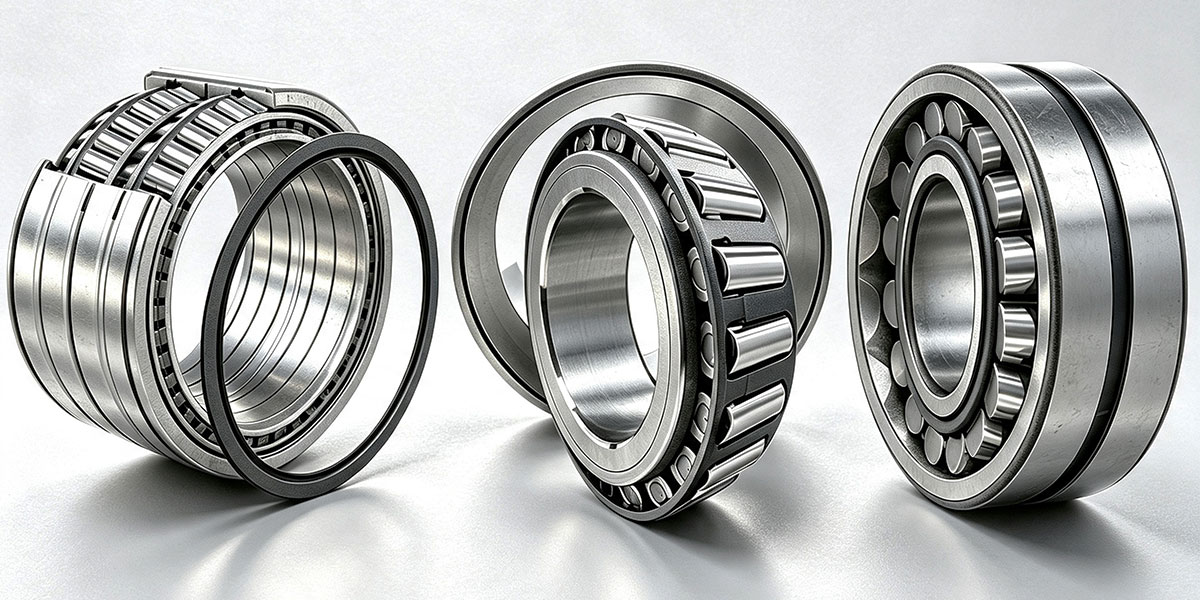
Bearing clearance is one of the most important factors affecting bearing performance, operating temperature, noise level, and service life.
For engineers, maintenance technicians, and bearing purchasers, understanding bearing internal clearance is essential for correct bearing selection, proper installation, and reliable equipment operation.
1. What Is Bearing Clearance?
Bearing internal clearance refers to the total amount of movement between the inner ring and outer ring of a bearing before installation and without external load.
This designed internal space allows the bearing to:
- Accommodate thermal expansion during operation
- Maintain an effective lubrication film
- Reduce friction and wear
- Ensure smooth and stable rotation
Bearing clearance is not a manufacturing defect. It is an essential design feature that compensates for changes caused by shaft and housing fits, operating temperature, and applied loads.
For most rolling bearings, radial internal clearance is the primary clearance parameter used for bearing selection and is classified into standard clearance grades such as C2, Normal (CN), C3, and C4.
2. Radial Clearance vs Axial Clearance
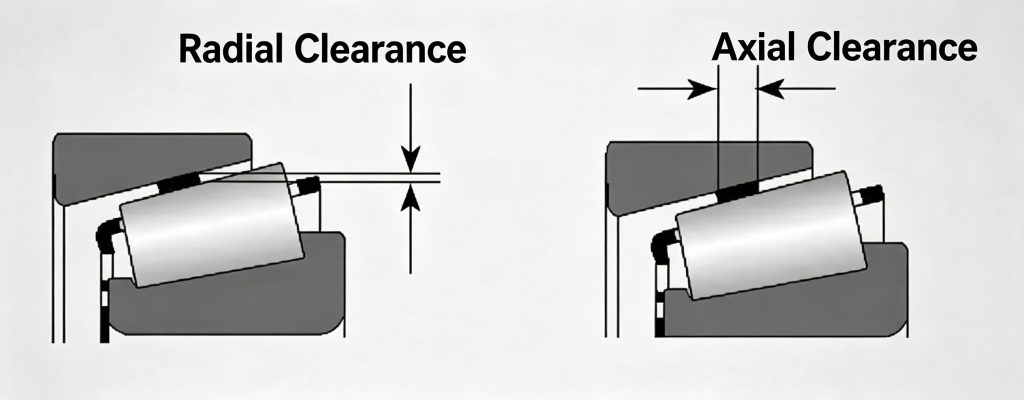
Bearing internal clearance is divided into radial clearance and axial clearance.
2.1 Radial Internal Clearance
Radial internal clearance is the amount of movement between the inner ring and outer ring in the radial direction before installation and without external load.
It is the most commonly specified clearance for rolling bearings.
The standard clearance codes C2, CN, C3, C4, and C5 refer to radial internal clearance.
2.2 Axial Internal Clearance
Axial internal clearance refers to the movement of one bearing ring relative to the other in the axial direction.
Its value depends on the bearing design and internal geometry and is especially important for applications requiring precise shaft positioning.
3. Bearing Clearance Grades Explained
Bearing internal clearance is classified into several standard grades. Normal (CN), C3, and C4 are the most commonly used in industrial applications.
| Grade | Description | Typical Applications |
|---|---|---|
| C1 | Smaller than C2, special applications | High-precision equipment |
| C2 | Smaller than Normal | Precision and low-noise equipment |
| Normal (CN/C0) | Standard clearance | General machinery |
| C3 | Larger than Normal | Electric motors, pumps, gearboxes |
| C4 | Larger than C3 | High-temperature and heavy-duty machinery |
| C5 | Larger than C4, special applications | Extreme operating conditions |
3.1 C2 Clearance
C2 clearance is smaller than Normal clearance and is suitable for applications requiring low noise and controlled operating conditions.
Typical applications
- Precision machinery
- Measuring instruments
- Low-noise electric motors
- High-accuracy equipment
Note: C2 clearance is generally not recommended for high-temperature applications or heavy interference fits, as the working clearance may become too small.
3.2 Normal (CN/C0) Clearance
Normal (CN/C0) is the standard clearance supplied for most rolling bearings.
It provides a balanced combination of running accuracy, operating temperature, and service life under normal working conditions.
Typical applications
- General industrial machinery
- Standard conveyors
- Light-duty gearboxes
- Agricultural equipment
3.3 C3 Clearance
C3 clearance is larger than Normal clearance and is the most widely used clearance grade in industrial applications.
It compensates for clearance reduction caused by:
- Higher operating temperatures
- Interference fits
- Continuous operation
Typical applications
- Electric motors
- Pumps
- Fans and blowers
- Gearboxes
- Industrial machinery
Example
6208-2RS/C3
- 6208 = Bearing series and size
- 2RS = Rubber seals on both sides
- C3 = Larger-than-normal radial internal clearance
3.4 C4 Clearance
C4 clearance provides more internal clearance than C3 and is intended for demanding operating conditions.
Typical applications
- High-temperature motors
- Mining equipment
- Vibrating screens
- Heavy-duty industrial machinery
3.5 C1 & C5 Clearance
C1 and C5 are special clearance grades used for specific operating conditions.
Compared with Normal, C3, and C4, they are much less common in general industrial applications.
4. Original Clearance vs Working Clearance
Understanding the difference between original clearance and working clearance is essential for selecting the correct bearing.
4.1 Original Internal Clearance
Original clearance is the internal clearance of a new bearing before installation.
It is measured under standard conditions without external load.
4.2 Working Clearance
Working clearance is the actual internal clearance after installation and during operation.
It is affected by:
- Shaft and housing fits
- Operating temperature
- Applied loads
The objective of selecting the appropriate clearance grade is to obtain the correct working clearance under actual operating conditions.
5. How to Choose the Right Bearing Clearance
The correct clearance depends on the operating environment.
| Application | Recommended Clearance |
|---|---|
| Precision equipment | C2 |
| General machinery | Normal (CN/C0) |
| Electric motors | C3 |
| Pumps and fans | C3 |
| Gearboxes | C3 |
| High-temperature equipment | C3 or C4 |
| Heavy-duty and mining machinery | C4 |
General Selection Guidelines
- Choose C2 for precision and low-noise applications.
- Choose Normal (CN/C0) for standard operating conditions.
- Choose C3 for most industrial motors and general machinery.
- Choose C4 for heavy loads, high temperatures, or severe vibration.
6. Common Problems Caused by Incorrect Clearance
Choosing the wrong clearance can reduce bearing performance and service life.
6.1 Clearance Too Small
Possible problems include:
- Increased friction
- Higher operating temperature
- Poor lubrication
- Premature bearing failure
6.2 Clearance Too Large
Possible problems include:
- Increased vibration
- Excessive running noise
- Reduced running accuracy
- Accelerated wear
Selecting the correct clearance helps ensure stable operation, lower friction, and longer bearing life.
7. Frequently Asked Questions
- Is C3 clearance better than Normal clearance?
Not necessarily. C3 clearance is recommended for applications with higher operating temperatures, higher speeds, or tighter interference fits. Normal clearance is suitable for most standard operating conditions.
- What does C3 mean on a bearing?
C3 indicates that the bearing has larger radial internal clearance than a Normal (CN/C0) bearing.
- Can a C3 bearing replace a Normal clearance bearing?
In many industrial applications, yes. However, the correct choice depends on operating temperature, load, speed, and mounting conditions.
8. Conclusion
Bearing internal clearance is a small but essential parameter that has a significant impact on bearing performance, operating temperature, vibration, noise, and service life.
Choosing the correct clearance is not simply a matter of selecting C2, C3, or C4—it requires considering operating temperature, load, rotational speed, mounting fits, and actual working conditions. The goal is to achieve the proper working clearance after installation, ensuring reliable operation and maximum bearing life.
Understanding the differences between clearance grades and selecting the right option for your application can improve equipment reliability, reduce maintenance costs, and extend bearing service life.
MBY supplies a wide range of rolling bearings with reliable quality, flexible OEM services, and professional technical support. We help customers select the right bearing solutions for a wide variety of industrial applications.