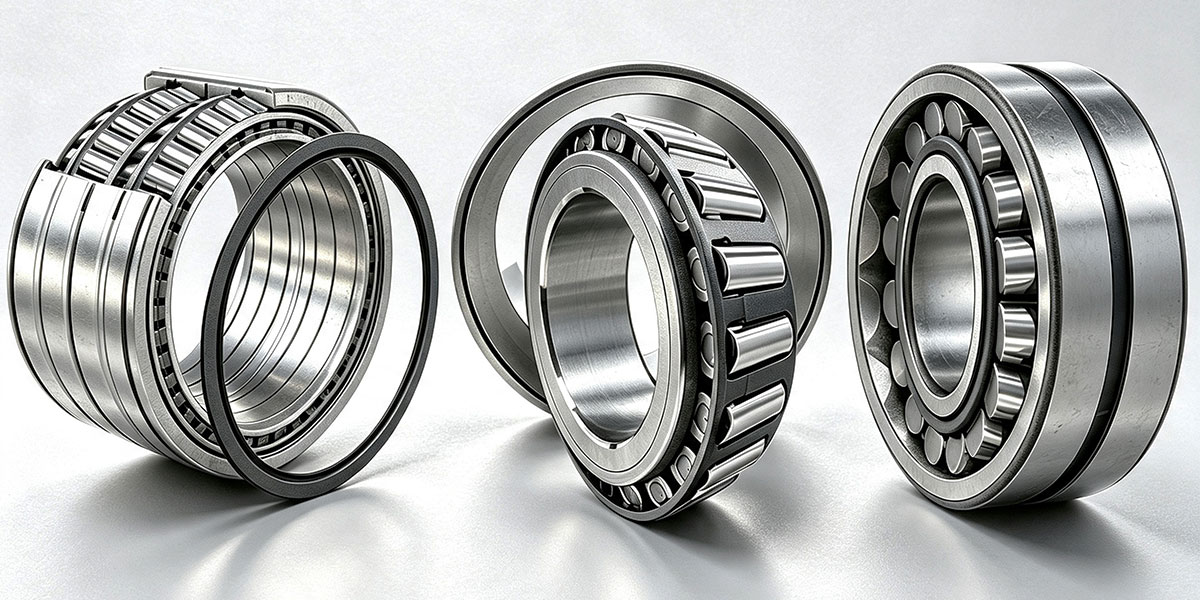
Bearing precision grades define the manufacturing accuracy of rolling bearings. They determine how closely a bearing’s dimensional tolerances, rotational accuracy, and running performance meet international standards.
Higher precision bearings provide better rotational accuracy, lower vibration, reduced noise, and more stable high-speed operation. However, tighter manufacturing tolerances also increase production complexity and cost.
Choosing the correct bearing precision grade helps achieve the best balance between accuracy, reliability, performance, and cost.
1. Definition of Bearing Precision Grades
Bearing precision grades specify the maximum allowable manufacturing deviations of bearings, including two main categories:
① Dimensional Accuracy
Including:
- Bore diameter tolerance
- Outside diameter tolerance
- Bearing width tolerance
② Rotational Accuracy
Including:
- Raceway accuracy
- Inner and outer ring radial runout
- Axial runout
- End face perpendicularity
- Rolling element dimensional consistency
Precision requirements are mainly defined according to ISO 492 for radial bearings and ISO 199 for thrust bearings, which are widely used by bearing manufacturers worldwide.
The smaller the allowable tolerance deviation, the higher the bearing precision.
2. Standard Bearing Precision Hierarchy
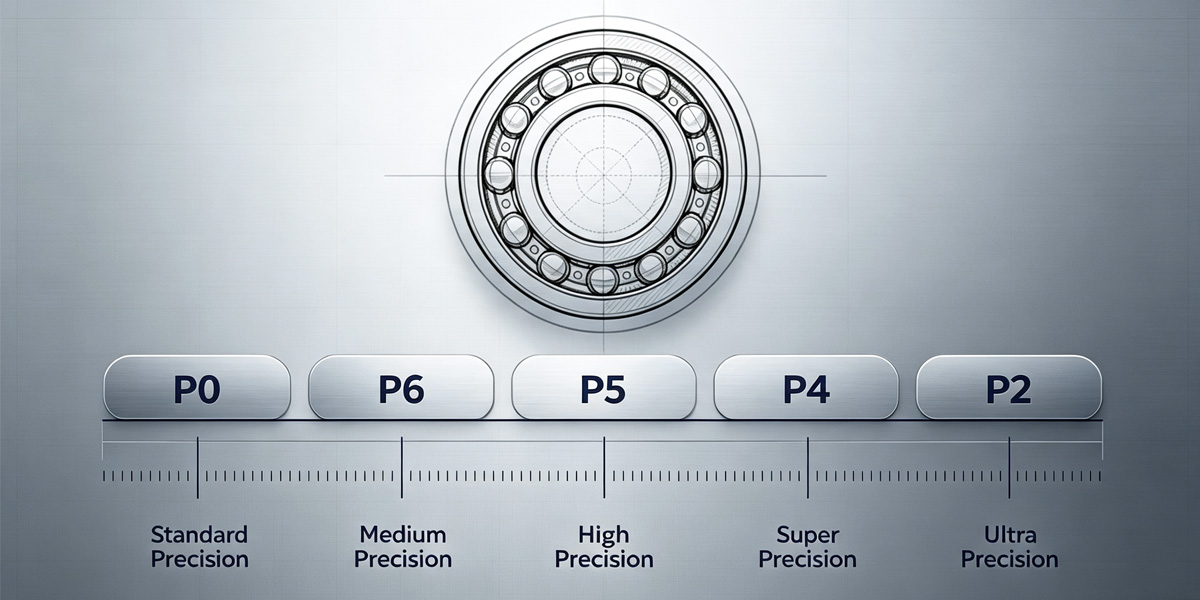
Common ISO precision ranking from lower to higher accuracy:
P0 < P6 < P5 < P4 < P2
| Precision Grade | Accuracy Level | Typical Applications |
|---|---|---|
| P0 (Normal) | Standard precision | General industrial machinery and conventional equipment |
| P6 | Higher precision than P0 | Electric motors, gearboxes, compressors, textile machinery |
| P5 | High precision | CNC equipment, precision reducers, robotics, measuring devices |
| P4 | Very high precision | CNC spindles, grinding machines, high-speed machining centers |
| P2 | Ultra-high precision | Semiconductor equipment, ultra-precision instruments, high-speed spindle systems |
The higher the precision grade, the tighter the manufacturing tolerances and the better the rotational accuracy.
3. Performance Benefits of Higher Precision Bearings
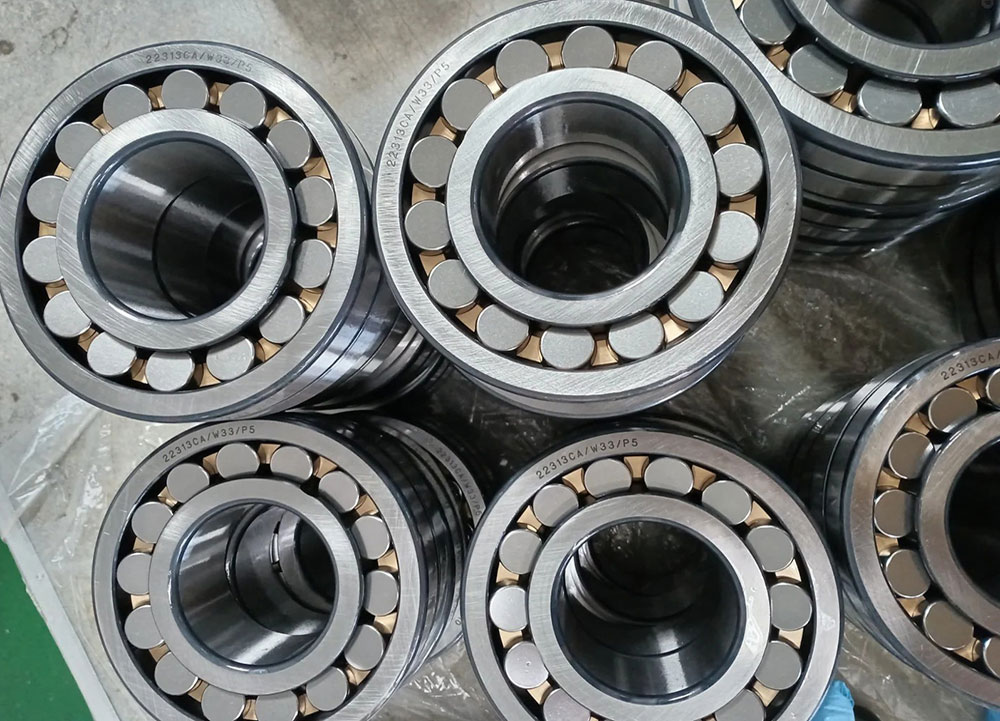
Compared with standard P0 bearings, high precision bearings provide:
- Higher dimensional accuracy
- Lower radial and axial runout
- Reduced vibration and operating noise
- Higher allowable rotational speed
- Improved positioning accuracy
- More uniform load distribution between rolling elements
Important Clarification
Higher precision does not increase the rated load capacity shown in bearing catalogs.
Bearing load ratings mainly depend on:
- Bearing type
- Bearing size
- Internal design
- Material
- Lubrication conditions
The main advantages of precision bearings are improved rotation accuracy, vibration control, and high-speed stability.
Under suitable operating conditions, better precision can also improve operational reliability and help extend service life.
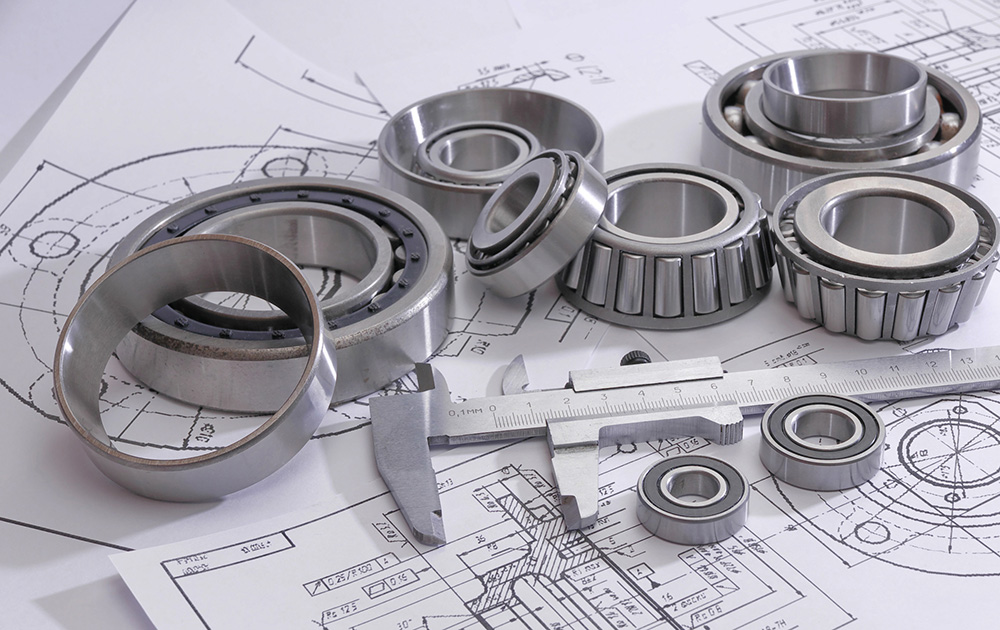
4. Applications of Different Precision Grades
① P0 (Normal Precision)
P0 is the standard bearing precision grade and the most widely used class worldwide.
Typical applications:
- Agricultural machinery
- Fans and blowers
- Water pumps
- Household appliances
- Conveyor systems
- General industrial equipment
② P6 Precision Grade
P6 bearings provide improved rotational accuracy and smoother operation compared with P0 bearings.
Typical applications:
- Electric motors
- Gearboxes
- Air compressors
- Textile machinery
- Packaging equipment
③ P5 Precision Grade
P5 bearings are designed for equipment requiring higher accuracy, smoother rotation, and better positioning performance.
Typical applications:
- CNC machine tool feed systems
- Ball screw supports
- Precision reducers
- Industrial robots
- Measuring equipment
④ P4 Precision Grade
P4 bearings are widely used in high-speed precision applications requiring low vibration and excellent rotational accuracy.
Typical applications:
- CNC spindle bearings
- Grinding machine spindles
- High-speed machining centers
- Precision spindle systems
⑤ P2 Precision Grade
P2 is an ultra-high precision grade used for applications requiring extremely tight accuracy requirements.
Typical applications:
- Semiconductor manufacturing equipment
- Ultra-precision measuring instruments
- Aerospace precision systems
- Ultra-high-speed spindle applications
5. Bearing Precision Grade vs Internal Clearance
Bearing precision grade and internal clearance are two different specifications and are often confused.
| Item | Bearing Precision Grade | Bearing Internal Clearance |
|---|---|---|
| Main function | Manufacturing accuracy | Internal operating gap |
| Controlled by | Machining tolerance during production | Selected according to application conditions |
| Classification | P0, P6, P5, P4, P2 | C2, CN, C3, C4, C5 |
| Main influence | Rotational accuracy, vibration, noise | Temperature, preload, operating performance |
Common Matching Examples
Precision grade and clearance are independent and can be combined according to application requirements:
- P5 precision + C3 clearance — Common for certain machine tool applications
- P6 precision + CN clearance — Common configuration for electric motors
- P4 precision + C2 clearance — Often used in preloaded spindle systems
The correct combination depends on speed, load, temperature, mounting conditions, and operating requirements.
6. How to Select the Correct Bearing Precision Grade
The correct precision grade depends on:
- Required accuracy
- Rotational speed
- Vibration requirements
- Equipment design
- Cost considerations
Using a higher precision bearing than necessary may increase cost without providing additional benefits.
| Equipment Type | Recommended Precision Grade |
|---|---|
| General machinery, fans, conveyors | P0 |
| Electric motors, compressors, gearboxes | P6 |
| CNC feed systems, precision reducers, robots | P5 |
| CNC spindle systems, grinding machines | P4 |
| Semiconductor equipment, ultra-precision systems | P2 |
Selection Tip
High precision bearings require accurate shafts, housings, proper lubrication, and correct installation methods to achieve their designed performance.
The required fitting accuracy depends on bearing type, preload, speed, load, and operating environment.
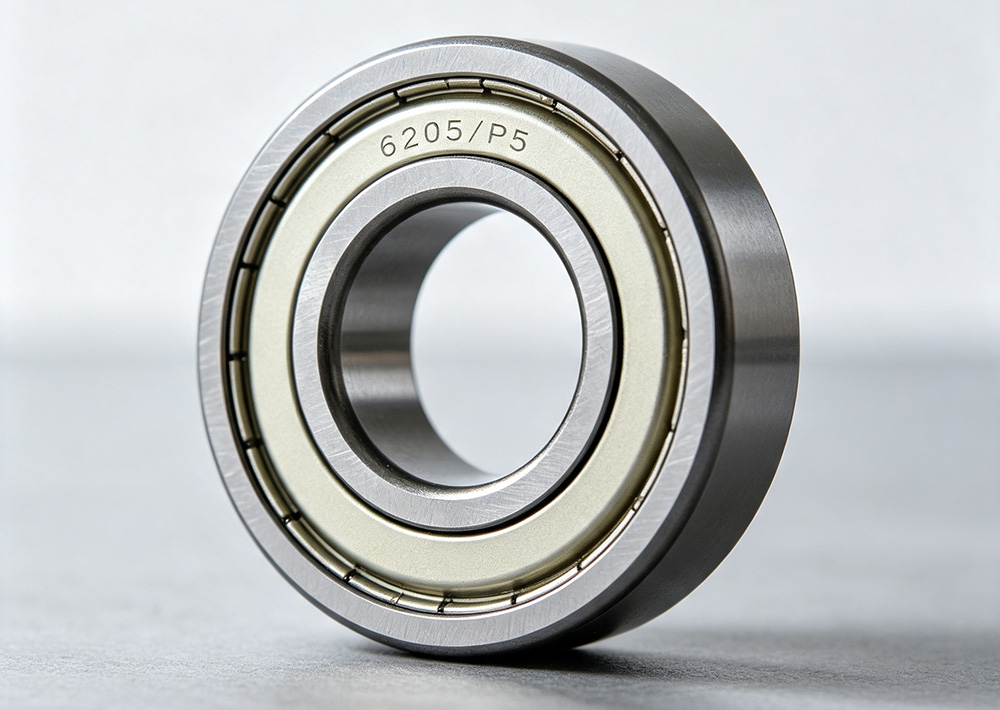
7. Bearing Marking Rules & Examples
In standard industrial practice, P0 precision is the default grade and is usually not marked.
Only higher precision grades are normally added as suffixes.
Examples:
- 6205 → Normal precision (P0)
- 6205/P6 → P6 precision deep groove ball bearing
- 6205/P5 → P5 precision bearing
- 7206AC/P4 → P4 precision angular contact ball bearing
- 7012C/P2 → P2 ultra-high precision angular contact bearing
8. Frequently Asked Questions
- Is P5 better than P6?
Yes. P5 bearings have tighter dimensional and rotational accuracy requirements than P6 bearings.
However, higher precision does not always mean better performance. P0 or P6 is usually sufficient for general machinery, while P5 is selected when higher accuracy and lower vibration are required.
- Does higher precision increase bearing load capacity?
No. Bearing load capacity is determined mainly by bearing design, size, material, and operating conditions.
Precision grades mainly improve rotational accuracy, vibration performance, and operational stability.
- Can I replace a P0 bearing with a P5 bearing?
Technically, bearings with the same dimensions can be interchangeable.
However, upgrading from P0 to P5 is only beneficial when the entire mechanical system, including shafts, housings, installation accuracy, and operating conditions, can support higher precision requirements.
Otherwise, the bearing may not achieve its designed performance.
- Is P4 always better than P5?
P4 provides higher precision than P5, but its advantages mainly appear in high-speed spindle systems and precision machinery.
For many industrial automation applications, P5 provides an excellent balance between performance and cost.
Conclusion
Bearing precision grades define the dimensional and rotational accuracy of rolling bearings. From P0 for general industrial applications to P2 for ultra-high precision systems, each grade is designed for specific performance requirements.
Selecting the correct bearing precision grade improves equipment accuracy, reduces vibration, enhances operating stability, and avoids unnecessary costs.